
Handmade Warmth: Rediscovering the art of the Kachelöfen

Updated: 5 days ago
What happens when a heating system becomes a piece of architecture, a functional work of art and the natural gathering place of a home?
I recently had the opportunity to visit the Guelph studio of Stone House Kachelöfen, where ceramic artist and Kachelofen builder Jessica Steinhäuser is preserving — and creatively reimagining — a centuries-old European tradition: the Kachelöfen.
I first met Jessica and learned about the art and science of the Kachelöfen in the spring with she presented at the Ontario Natural Building Conference, and was excited about the opportunity to see her studio in person and learn more about the process of designing and building this traditional heating system in a modern home.
As an interior designer with a particular interest in Building Biology, healthy materials and sustainable building practices, I was intrigued by the way a Kachelöfen brings so many principles together. It provides gentle radiant warmth, uses thermal mass to make efficient use of wood, and can be completely customized to become an integral part of a home’s architecture and daily life.

What Is a Kachelöfen?
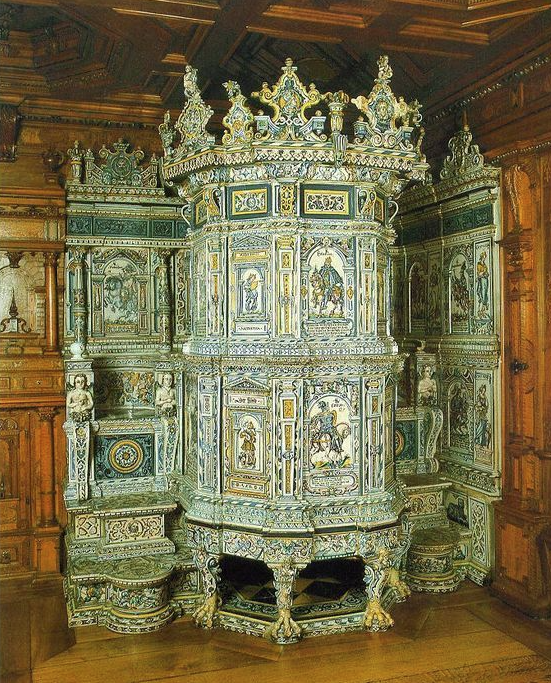
A Kachelöfen — pronounced approximately kah-kel-oh-fen — is a type of masonry heater traditionally constructed with an exterior layer of ceramic components called Kacheln. (singular: Kachel, plural: Kacheln)
Although Kacheln may appear to be conventional tiles, they are actually three-dimensional, hollow, brick-like ceramic pieces. During construction, they are filled or backed with firebrick and mortar, adding thermal mass and helping the heater distribute warmth evenly across its surface.
Inside the Kachelofen is a fire chamber connected to a carefully designed network of firebrick flue channels. A relatively small amount of wood is burned quickly and at a high temperature. Rather than allowing most of the heat to escape directly through the chimney, the hot gases travel through the internal channels, transferring their heat into the masonry. Once the fire has burned down and the damper is closed, the heat stored within the firebrick, mortar and ceramic Kacheln is slowly released into the home. Stone House explains that one fire can provide approximately eight to twelve hours of steady radiant warmth.
The result is quite different from the intense, localized heat of a conventional metal wood stove. Instead of becoming extremely hot and cooling quickly once the fire is out, a Kachelöfen acts almost like a thermal battery — absorbing, storing and gradually releasing warmth over many hours.

A Heating Tradition Centuries in the Making
Thermal-mass heating is not a new concept. People have been using masonry, earth and stone to capture heat from fire for thousands of years. What we now recognize as the Kachelöfen was further developed and refined in German-speaking Europe during the Renaissance, when specialist stove builders known as Hafnermeister established a distinct building tradition.
Kachelöfen became especially associated with Germany, Austria, Switzerland and other parts of Central and Northern Europe. In cold climates where firewood was valuable, their ability to extract and retain more heat from each fire offered an important practical advantage.
The ceramic exterior also transformed the heater into much more than a utilitarian appliance. Over time, Kachelöfen became significant architectural features within homes, ranging from highly ornamented traditional forms to simpler farmhouse styles.
Today, the underlying principle remains much the same: a short, hot fire charges a large thermal mass, which then releases comfortable heat slowly and continuously.

Radiant Heat Through a Building Biology Lens
One of the aspects that interests me most is the quality of the heat itself.
Building Biology considers radiant heat to be a biologically preferable method of heating an indoor environment. Rather than relying primarily on the movement of heated air, radiant heat warms the people, furnishings and surrounding surfaces within a room — similar to the sensation of standing in the sun on a cold winter day.
This creates several potential benefits for indoor environmental quality.
Gentle, Even Comfort
A Kachelöfen releases warmth across a large ceramic surface at a relatively steady temperature. This helps reduce the uncomfortable cycle of overheating and cooling that can occur with some conventional heating systems. Because the warmth is stored within the masonry, the heater continues to radiate long after the visible fire has gone out. The experience is less about standing beside an intense heat source and more about inhabiting a room surrounded by gentle warmth.
Less Air Movement
Forced-air systems distribute heat by moving large volumes of air throughout a building. That air movement can also redistribute dust, allergens and other settled particles, and creates a lot of noise. A Kachelöfen does not depend on continuous air circulation to deliver its warmth. From a Building Biology perspective, reducing unnecessary air movement can contribute to a calmer and more comfortable indoor environment, particularly for occupants who are sensitive to dust or drafts.
(Radiant heating does not replace the need for appropriate ventilation and fresh-air exchange. Heating and ventilation are separate functions, and a healthy home still requires a well-designed strategy for supplying fresh air and managing indoor pollutants.)
Less Drying of the Indoor Air
The gentle surface temperature and limited air movement associated with radiant heat can also feel less dry than the concentrated heat and constant circulation produced by conventional systems.

Making Better Use of Every Fire
The energy efficiency of a Kachelöfen comes from both its combustion strategy and its ability to store heat.
A conventional open fireplace sends a significant portion of its heat directly up the chimney. A metal wood stove captures more of that heat, but generally requires regular refueling and begins cooling soon after the fire dies down. A masonry heater is designed differently. Wood is burned rapidly with an adequate supply of air, creating the high temperatures needed for more complete combustion. The hot gases are then directed through internal heat-exchange channels before reaching the chimney. The masonry absorbs that energy and releases it gradually into the building.
This can mean fewer fires, less frequent tending and more useful heat captured from each load of wood.

Actual performance will always depend on the heater design, the building envelope, the moisture content of the firewood and how the system is operated. A Kachelöfen must also be correctly sized for the home rather than treated as an ornamental feature that happens to produce heat. As with every wood-burning appliance, professional design, proper installation, an appropriate chimney and air intake, carbon-monoxide protection, dry fuel and compliance with local codes are essential.
Far More Than a Heater
From a design perspective, one of the most exciting aspects of a Kachelöfen is the customization of colour, style and design.
Stone House also offers four core styles — the Franken, Muskoka, Roslyn and St. Gallen — but these serve as starting points rather than rigid final products. The size, shape, proportions, details and functions can be adapted to suit the project.

But what really gets me excited is how a custom-designed Kachelöfen can be integrated into a home. The homeowner, designer and builder can work together to develop a piece based on the architecture, heating requirements and daily rituals of the household.
A Kachelöfen may be:
Freestanding or integrated against a wall
Designed to serve more than one room
Constructed as a double-sided feature
Extended vertically to provide heat on another floor
Combined with a built-in warming bench
Fitted with a cooktop or cookstove
Designed with a bake oven, pizza oven or warming shelf
Integrated with surrounding cabinetry, seating or architectural elements
Stone House has created projects that combine the heater with wood-fired cooktops and bake ovens, as well as designs incorporating hardwood warming benches and personalized reading nooks. These additions can transform the heater into a true center of household life—a place to gather, cook, rest and warm up.

Ceramic Art Made for the Home
The design possibilities extend far beyond the form of the heater. Jessica and the Stone House team make the Kacheln by hand, using techniques that may include pressing, rolling, carving, sculpting and slip trailing. Glazes can range from quiet whites and earthy neutrals to deep greens, rich reds and vibrant cobalt blues.
Custom details can include:
Family crests
Meaningful dates
Poetry or handwritten inscriptions
Botanical and regional motifs
Sculptural relief
Traditional decorative patterns
Contemporary geometric designs
Custom trim, crowns, ledges and base profiles
Personalized glaze colours
Antique or specially commissioned accent tiles
Stone House has even incorporated poetry directly into a Kachelofen and developed patterns inspired by heritage architecture, flowers, landscapes and family history.
This level of personalization allows each installation to respond to the home and its occupants. It can feel historic, rustic, Scandinavian, contemporary, whimsical or quietly minimal. It can blend into the architecture or become the room’s defining focal point.
In many ways, a Kachelofen sits at the intersection of interior design, ceramic art and building science.

Jessica Steinhäuser and Stone House Kachelöfen
At the centre of Stone House is Jessica Steinhäuser, an award-winning Canadian ceramic artist who studied pottery formally in Germany before immigrating to Canada and establishing Stonehouse Pottery in downtown Guelph in 1989. Inspired by memories of the Kachelofen in her childhood home, Jessica later returned to Europe to study with experienced Kachelofen builders in Austria. She completed her first Kachelofen in 2008 and has since developed a body of work recognized for its vibrant colour, architectural sensitivity, clean lines, handcrafted detail and integration of functional heating with ceramic art. Jessica is North America’s only dedicated custom Kachelofen maker — a particularly remarkable distinction within a building tradition that has existed in Europe for centuries.
What makes her work so compelling is that she is not simply reproducing historical stoves. She understands and respects the traditional principles behind them while allowing each piece to reflect its own setting and story.
Her Kachelöfen are simultaneously ancient and contemporary, practical and expressive. They are heating systems, gathering places and large-scale ceramic installations designed to become a permanent part of the architecture.

Bringing Warmth Back to the Centre of the Home
My visit to Stone House Kachelöfen was a reminder that some of the most forward-thinking approaches to healthy and sustainable design are not necessarily new. Sometimes they come from revisiting time-tested methods and thoughtfully adapting them for the way we live today. A Kachelofen uses simple materials—clay, firebrick, mortar and wood—to create long-lasting radiant comfort. It can reduce reliance on constantly operating mechanical systems while adding beauty, craftsmanship and a meaningful sense of place.
Most importantly, it brings warmth back to the centre of the home—not only as a temperature, but as an experience.
For anyone interested in natural materials, radiant heating, resilient building systems or truly custom residential design, the work being created by Jessica and Stone House Kachelöfen is well worth discovering.


Comments